 |
| Makedonska Narodna Ora, Jugoton Zagreb, LPY-50985, ~1972 |
The Acquisition
I came by this LP not in a record store, but in the very back of an upscale thrift store. NYC's Vintage Thrift mostly specializes in clothing, furniture, antiques, and other collectibles, and seems to welcome donations of the vinyl kind. Though the store contained plenty of the standard bargain-bin detritus, there was also an unusually substantial selection of great ethnic folk music - including lots of old recordings of Yugoslav song and dance. This leads me to believe that those records, "Makedonska Narodna Ora" included, came from the collection of an older Slav, who may have purchased it overseas.
Though I have a certain fondness for nature imagery, pre-Photoshop image superimpositions, and Macedonian bagpipers in traditional garb, the album cover wasn't the main thing that grabbed my attention. What grabbed me was the This is the first and only vinyl record of Macedonian music that I've ever come across. While it doesn't contain my favorite song, "Dvajspetorka," a lively romp in 25/8 time, it features many other fantastic and "undanceable" odd-meter dances.
 |
| Pece Atanasovskoga and gajda |
Some Context
The venerable gajda player pictured on the album cover is Pece Atanasovskoga (or Atanasovski), a veteran leader of Yugoslav state folk song and dance ensembles by the time of this recording in the early-mid 1970s. He played a complex role as a bearer of "authentic" folk traditions in an era when these traditions were being recontextualized, standardized, and marketed by the Socialist state apparatus.
These state-sponsored folk culture ensembles are extremely interesting to study critically. They took traditions formerly transmitted from person to person and performed in intimate social, dance, and sometimes spiritual contexts and moved them to the international stage. The concert hall, with its defined dichotomy between performers and audience members, was a significant factor in the "classicalizing" of folk forms. In this new context, ensembles created a new representation of folk culture that was often marketed to foreigners while claiming "authenticity" - a loaded claim, considering the hybridity of practices engineered by the new space, new performance standards, and new pedagogical approaches. We'll go into greater depth about these issues in the next LP I post, of the famous Moiseyev Dance Ensemble.
A Look at the Record and the Music
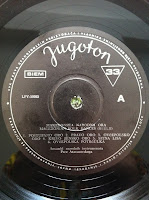
The vinyl record provides an interesting lens through which to view the musical changes of the socialist era, as it embodies the process of decontextualization inherent in folk musics. Jugoton, the largest record label of Yugoslavia, was responsible for recording, producing, and packaging the musics of Yugoslav state ensembles for distribution and export. Considering this, there is a distinct dearth of information supplied on this record. Atanasovski is backed by an anonymous group of musicians, only referred to as "Ansambl narodnih instrumenata," or "ensemble of folk instruments." This record gives no information at all on the dances or the music, implicitly forcing the music to stand on its own. Moreover, this sounds nothing like any dance music you've ever heard, which enforces the fact that a prime factor of context is the listener's cultural background. When confronted with music like that of this record, my reaction is to listen in enraptured amazement. Thus, a soundtrack for social dance becomes the object of a solitary, involved listening experience when its context is altered. Because of the hybridity of transmission inherent in the state ensemble and Atanasovski's own pedagogy, it is impossible for me to tell whether this is presented as "authentic" dance music or pieces geared more toward listening.

 The majority of the world's dance music (seen from a Western analytical perspective) is in symmetrical meters like 4/4 and 3/4 or 6/8, although one of the most ubiquitous rhythms is formed by subdividing a bar of 4/4 into 8th notes, grouped 3-3-2. The majority of Macedonian dance music on this record, however, is in asymmetrical meters like 5/8, 7/8 and others of even greater complexity.
Such meters are far removed from what we consider dance music in our culture, and are more often identified with progressive art musics - hence my tongue-in-cheek reference to "undanceable" dances earlier in this post.
The rhythms on this record are intoxicating, perhaps the music's most striking factor to my ears. They stutter, lurch, and sway, sometimes evoking the lumbering movements of a great beast. The percussionist creates this sense of rhythmic compression and expansion by anticipating or delaying the beat. No matter how affected the beat becomes, however, the rhythmic and melodic instruments are always locked in perfect time with each other.
In considering these rhythms, another issue of personal context arises. In Western classical music, meter is explained as a divisive phenomenon: 4/4 means that a 4-beat bar is divided into 4 equal units. In Eastern forms such as the Indian tala, however, meter is thought of additively: a 4 beat cycle, composed by adding a 2-beat unit to another. While divisive and additive meters can produce similar sonic results, they do have tangible effects on performance, composition, and analysis. Different ways of thinking about meter allow us to experience and create the music in different ways.
Additive melodies often follow from additive metric systems, and in this music we often hear melodic phrases built by the small groupings - everything, even the most mindbendingly complex passages on this record can be explained as additions of twos and threes. The melodic contours themselves are simple as well, with focus on a stable, percussion-anchored line.
The dynamically off-kilter rhythms of many of these dances highlight a difference in instrumental role between Macedonian dance music and most other musics. We're used to hearing percussion play the role of timekeeper, anchoring the ensemble. Here, the percussion's role seems to be rhythmic play and propulsion, feeding off the invisible dance. The tambura, a long-necked lute with four doubled courses, similar to a bouzouki or mandolin in the guitar range, keeps time throughout by playing a constant stream of notes.
Atanasovski's gajda leads the ensemble on most tunes, providing the tonic drone and nimble melody over the perceived "chaos" of the percussion. This is the album and instrument that will help you fall in love with the bagpipes, purging your mind of that one unskilled Scottish piper you heard that one time who instilled an indiscriminate hatred of the instruments in you. The gajda's sound is more substantial, less bleating and shrill than the more familiar Scottish highland pipes. Its rich, reedy drone and soaring melodies have a more pleasant, balanced and rounded tone.
The other regional instruments of the Ansambl are the kaval, an end-blown flute played across the Balkans and Asia Minor, the tapan drum, the shrill double-reed zurla. There is also a more conventional Balkan ensemble on some tunes, featuring violin and clarinet as the main melody instruments. Interestingly enough, there are also moments that remind me of Indian and Tibetan temple music, the zurla and tapan resembling the sounds of the nagaswaram and thavil.
But I implore you - listen and draw your own conclusions about this wonderful music. Don't forget my favorite activity - attempting to count the beat cycles and understand the meters. With music this challenging and rewarding, it stays fun and doesn't get easy too quickly.
Hope this post hasn't been prohibitively long! ENJOY!
 |
| The track listing - featuring markings of the previous owner's preferences |

 The majority of the world's dance music (seen from a Western analytical perspective) is in symmetrical meters like 4/4 and 3/4 or 6/8, although one of the most ubiquitous rhythms is formed by subdividing a bar of 4/4 into 8th notes, grouped 3-3-2. The majority of Macedonian dance music on this record, however, is in asymmetrical meters like 5/8, 7/8 and others of even greater complexity.
Such meters are far removed from what we consider dance music in our culture, and are more often identified with progressive art musics - hence my tongue-in-cheek reference to "undanceable" dances earlier in this post.
The rhythms on this record are intoxicating, perhaps the music's most striking factor to my ears. They stutter, lurch, and sway, sometimes evoking the lumbering movements of a great beast. The percussionist creates this sense of rhythmic compression and expansion by anticipating or delaying the beat. No matter how affected the beat becomes, however, the rhythmic and melodic instruments are always locked in perfect time with each other.
In considering these rhythms, another issue of personal context arises. In Western classical music, meter is explained as a divisive phenomenon: 4/4 means that a 4-beat bar is divided into 4 equal units. In Eastern forms such as the Indian tala, however, meter is thought of additively: a 4 beat cycle, composed by adding a 2-beat unit to another. While divisive and additive meters can produce similar sonic results, they do have tangible effects on performance, composition, and analysis. Different ways of thinking about meter allow us to experience and create the music in different ways.
Additive melodies often follow from additive metric systems, and in this music we often hear melodic phrases built by the small groupings - everything, even the most mindbendingly complex passages on this record can be explained as additions of twos and threes. The melodic contours themselves are simple as well, with focus on a stable, percussion-anchored line.
The dynamically off-kilter rhythms of many of these dances highlight a difference in instrumental role between Macedonian dance music and most other musics. We're used to hearing percussion play the role of timekeeper, anchoring the ensemble. Here, the percussion's role seems to be rhythmic play and propulsion, feeding off the invisible dance. The tambura, a long-necked lute with four doubled courses, similar to a bouzouki or mandolin in the guitar range, keeps time throughout by playing a constant stream of notes.
Atanasovski's gajda leads the ensemble on most tunes, providing the tonic drone and nimble melody over the perceived "chaos" of the percussion. This is the album and instrument that will help you fall in love with the bagpipes, purging your mind of that one unskilled Scottish piper you heard that one time who instilled an indiscriminate hatred of the instruments in you. The gajda's sound is more substantial, less bleating and shrill than the more familiar Scottish highland pipes. Its rich, reedy drone and soaring melodies have a more pleasant, balanced and rounded tone.
The other regional instruments of the Ansambl are the kaval, an end-blown flute played across the Balkans and Asia Minor, the tapan drum, the shrill double-reed zurla. There is also a more conventional Balkan ensemble on some tunes, featuring violin and clarinet as the main melody instruments. Interestingly enough, there are also moments that remind me of Indian and Tibetan temple music, the zurla and tapan resembling the sounds of the nagaswaram and thavil.
But I implore you - listen and draw your own conclusions about this wonderful music. Don't forget my favorite activity - attempting to count the beat cycles and understand the meters. With music this challenging and rewarding, it stays fun and doesn't get easy too quickly.
Hope this post hasn't been prohibitively long! ENJOY!
 |
| Some almost-intelligible writing on the cover - perhaps an autograph from Pece Atanasovski himself! |
